

Escalation is a risk often underestimated at contract execution and difficult to recover once costs shift. A lack of appropriate provisions can leave contractors without a clear pathway to a legitimate escalation claim. This article identifies the fundamentals required to prepare for an effective claim from understanding its causes, to navigating contractual entitlement and quantifying the loss.
What is Escalation and Driving Causes
Escalation is a mechanism used to protect a contractor from market volatility. Globalised supply chains, labour constraints, more complex projects and contracting risk allocation have all contributed to the risk of escalation in modern day construction.
COVID-19 disrupted supply through reduced material output, shipping congestion and container shortages, while simultaneously inflating demand through stimulus packages. Together, these forces placed significant upward pressure on material and labour costs across the Australian construction sector. This was further compounded by the Russia-Ukraine War, which saw an increase in steel, fuel and energy costs and further reduced global raw material output.
In more current times, conflict in the Middle East and restrictions through the Strait of Hormuz have resulted in a global energy shock, compounded by disruption in the Red Sea extending freight lead time and increased logistical costs. These pressures add to the pre-existing constraints of skilled labour shortages, fragile supply chains and ongoing tariff and trade policy uncertainty, all of which contribute to cost escalation on projects in Australia. Taken together, these forces have created a cost environment that is both volatile and likely to be sustained. Standard contracts are poorly equipped to manage this risk without express provisions.
Escalation in standard contracts in Australia
The most effective contractual protection against escalation is an express rise and fall clause. Previous versions of the Australian Standard suite of contracts expressly contemplated rise and fall provisions, however newer forms have removed such clauses.
Evidence of this past can still be seen in the drafting of daywork provisions in AS2124-1992 and AS4300-1995, which acknowledge the historical rise and fall provisions:
‘Amounts payable for Daywork shall not be subject to adjustment for rise and fall in costs notwithstanding that the Contract may provide for adjustment for rise and fall in costs.’ (s.41)
To facilitate a rise and fall mechanism, the more modern forms of the Australian Standard suite require an amendment or annexure to be introduced.
The General Conditions of Contract (GC21) provides a pathway to introduce a rise and fall mechanism by reference to Schedule 7 – Cost Adjustments Formula. However, by default this item is blank and any mechanism must be introduced and agreed by both parties.
The most effective means of mitigating escalation exposure is to ensure the contract contains express pathways for cost adjustment. These can include:
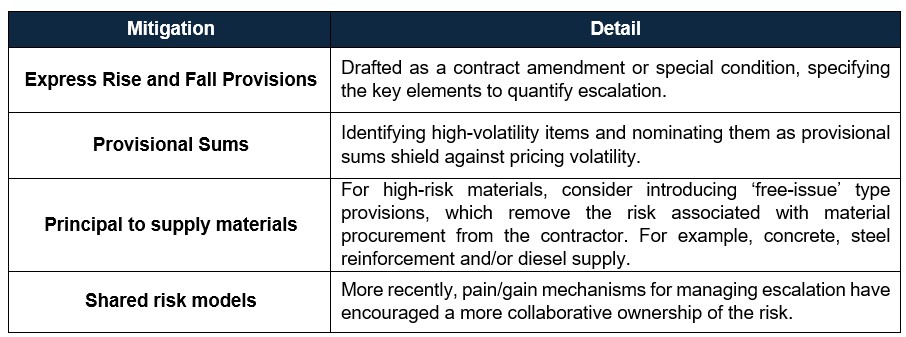
The measures above are not mutually exclusive, a combination of them can provide the most effective means of escalation recovery. The use of express rise and fall provisions addresses escalation globally whereas the use of provisional sums and material supply agreements can target specific high-risk items. The commonality between them all is that they require proactive preconstruction engagement. Without an express entitlement to escalation, recovery becomes more complex and less certain. The available alternatives in that scenario are addressed below.
Entitlement outside of express terms
In the absence of a rise and fall provision within the contracts, contractors are not without options. There are several mechanisms which can provide a pathway to recovery of escalation costs due to a ‘qualifying event’. These may include, but are not limited to:
- Changes to the WUC or Works
- Latent / Adverse Conditions
- Delay and Prolongation Claims
- Acceleration directions
All the above items allow for a contractor to submit a claim for costs that implements current market rates[1]. Each of these mechanisms provides a contractual gateway through which escalation costs, priced at the time of the qualifying event, can be recovered.
A change to the WUC or the Works can often provide a pathway to escalation cost recovery. These changes can occur several ways, including (but not limited to):
- a Variation direction by the principal
- a change in statutory or legislative requirements
- a change in sequencing and/or work methodology by the principal
A direction from the principal for a change in scope typically entitles the contractor to value the change at current market rates. This allows for the recovery of escalation costs, particularly during times of significant market movement.
Similarly, another effective pathway can be delays linked to compensable extensions of time. Costs recoverable are assessed on the time at which the delay was suffered, this is significant as it can push work into a period of higher market rates. In circumstances where there is no daily cap (or the cap is suitably high), a contractor can prorate the total escalation amount over the period of delay as part of the claim for delay costs/damages.
However, this pathway is often imperfect because of the restrictive nature of recoverable costs that flow from compensable extensions of time, which are generally limited to unavoidable, indirect costs.
Where a compensable extension of time does not exist, a ‘cap-in-hand’ exercise can be a final course of action. Approaching the principal with a transparent and objectively supported claim should not be overlooked, particularly in the public sector.
[1] Subject to valuation provisions within the contract, e.g. a defined schedule of rates.
Quantifying escalation
The simple best way to quantify escalation is by demonstrating (by reference to quotations, purchase orders or signed agreements) that the cost of material and/or labour has increased between two points in time. By linking the two points in time to a ‘qualifying event’, the claim for escalation can be justified.
However, this is rarely the case in practice. In this scenario, an effective escalation claim can be produced using a set of core steps each backed by a specific set of supporting documentation, as set out below.
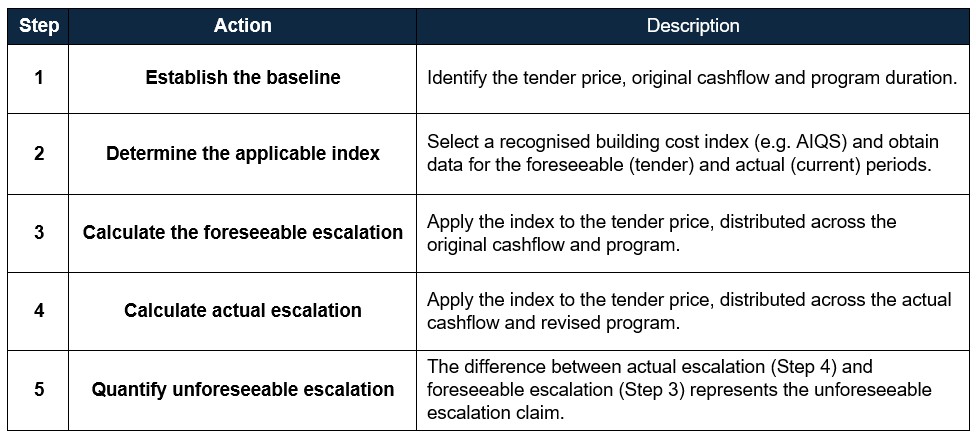
The methodology above provides the basis for a structured and defensible escalation claim. The graph below illustrates how foreseeable and actual escalation interact on a typical construction project over a revised program.
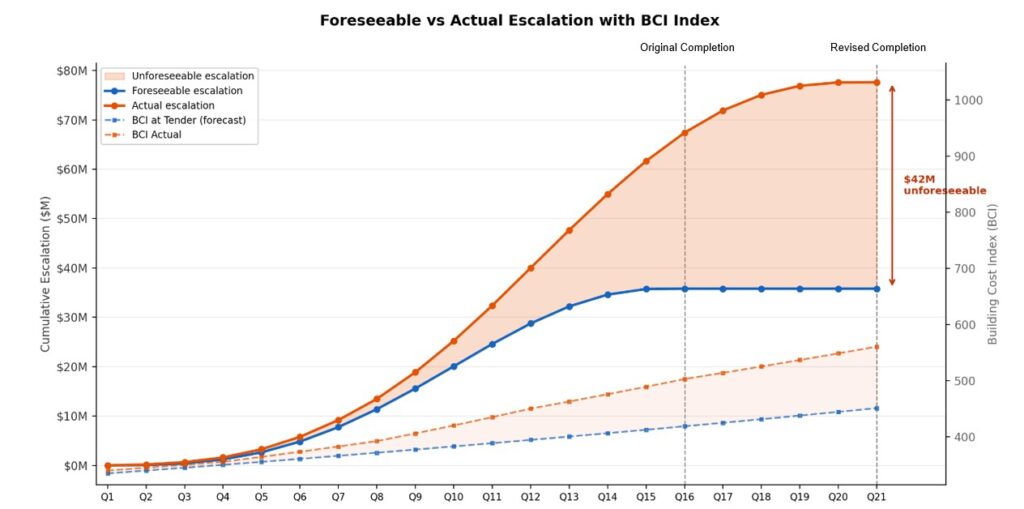
The original cashflow reflects costs as priced at tender, reflecting the escalation anticipated at that time. The revised cashflow demonstrates the same project following a program extension, with escalation applied to the actual spend profile. The difference between these two numbers is the unforeseeable escalation.
Conclusion
Escalation remains a commercially significant and underestimated risk in construction contracting. By default, commonly used forms of contracts will not provide for escalation. Rise and fall provisions must be introduced through carefully drafted amendments or annexures at the preconstruction stage. The absence of these provisions does not extinguish recovery, but it makes it significantly harder. Variations, prolongation claims and other change each offer alternative pathways, provided the appropriate commercial data exists to support them.
Escalation is best proven by direct before-and-after evidence. Quotations, purchase orders and signed agreements demonstrating the cost movement between two points in time are a significant advantage. Where that evidence is unavailable, the index based cashflow comparison methodology provides a transparent and defensible alternative. In either case, the strength of the claim depends entirely on the quality of the underlying data.
Calibrate specialise in escalation claims across all sectors and all contract forms. If you would like to discuss how escalation may be applicable on your project, please reach out and we would be glad to discuss with you further. info@calibrateconsulting.com.au.