

In the final part of this series, we investigate what record keeping methods can be implemented so that claims are properly substantiated during the project delivery phase.
KEY TAKEAWAYS
- Effective disruption management relies on early identification and contemporaneous records that demonstrate cause and effect.
- Productivity-based analysis – in particular the measured mile method – generally provides the most persuasive foundation for substantiating a disruption claim.
- Detailed and consistent records allow a clear delineation between compensable and non-compensable disruptive events, which is critical to the success of any disruption claim.
INTRODUCTION
In Parts 1 and 2 of this series, I introduced the concept of disruption and how it can be managed in the pre-contract and project setup stages of a project.
This third article delves into how to manage disruption in the project delivery phase and sets out proper record keeping methods. These are the core principles to ensure project teams effectively manage disruption.
PART 1 & 2 REFRESHER
Part 1 focused on managing disruption in the pre-contract phase and simple processes that can be undertaken to change the risk profile within a contract and ensure provisions are in place to account for disruption.
Part 2 focused on managing disruption in the project setup phase, outlining how effective systems, tracking tools and team training can be used to identify, measure and manage disruption. Key systems discussed included baseline programs and basis of schedule documents, labour and progress tracking tools and daily diary record systems.
To revisit Part 1, please click the following link.
To revisit Part 2, please click the following link.
THE PROJECT DELIVERY PHASE
Disruption in the Delivery Phase
Disruption in the delivery phase is rarely a single, isolated event. Instead, it accumulates through inefficiencies, coordination issues and unforeseen changes leading to a loss in productivity. During the delivery phase of the project, it is important to recognise when productivity loss occurs and properly document the causes so that claims can be substantiated and contractual entitlement demonstrated.
While the pre-contract and setup phases establish the systems and processes to identify and capture information on disruption, the delivery phase is where those systems must be actively used and enforced.
This article addresses five key elements of a disruption claim:
- Record Keeping: maintaining accurate construction records to identify productivity losses and record causation contemporaneously.
- Contractual Notices: issuing contractual notices within the required timeframes;
- Analysis and Quantification: analysing and quantifying the impact of disruption using recognised methods;
- Causation and Apportionment: addressing causation and the complications that arise from where multiple disruptive events overlap or interact; and
- Mitigation: documenting mitigation measures to demonstrate that reasonable steps were taken to minimise impact.
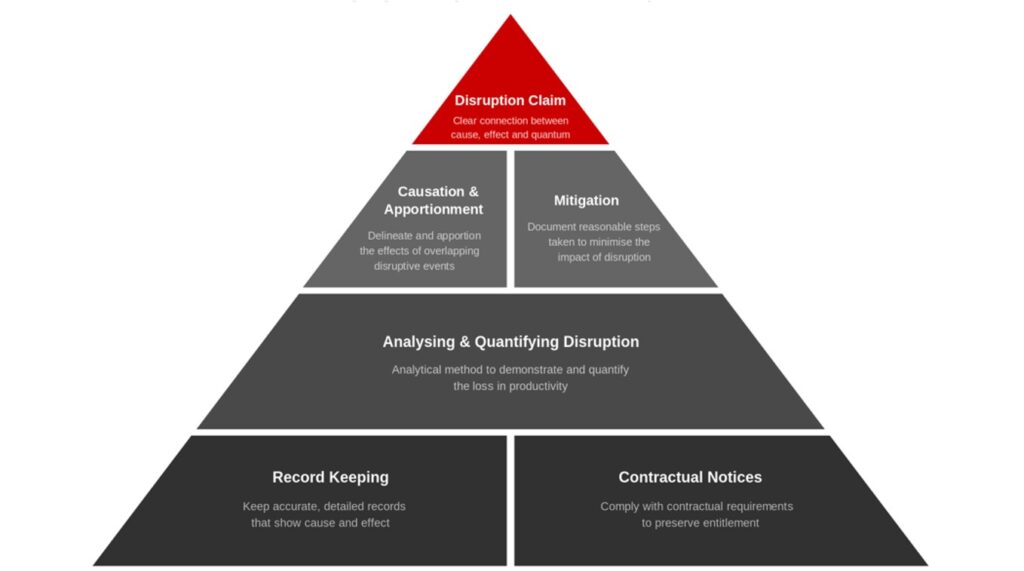
Record Keeping
Proper record keeping is the foundation for preparation and substantiation of a disruption claim. Examples of the types of records (apart from contractual notices) that are fundamental in preparing a disruption claim include:
- Design logs / RFI registers
- Statused programmes
- PCG or monthly report meetings and minutes
- Daily progress records (showing installation quantities)
- Daily site diaries
- Daily timesheets
- Site photos (particularly timelapse photos)
Proper records allow identification of both the cause and effect of disruption. This is central to developing an effective narrative and is a core component of any disruption claim.
Accuracy and consistency are two key elements to keep in mind when maintaining project records. Accuracy requires records to contain sufficient detail to identify the cause of the disruption and quantify its effects.. For example, an entry within a site diary should outline:
- Cause – The materials were delivered at 10:30 AM and were four hours late. The materials were not organised as specified in the delivery instructions.
- Effect – the work crew remained on standby from 6:30 AM and took additional time to organise the materials due to incorrect delivery. Total time lost by the crew was seven hours.
Consistency means describing the cause and effects of a particular disruptive event in a concise and consistent manner each time it occurs. This also extends to recording instances when the disruptive effect is absent. The result is a vastly simpler and more efficient process when pursuing a disruption claim.
These records also form the basis of the analytical methods used to quantify disruption, whether by programme-based analysis, productivity-based analysis, or a combination of both.
Contractual Notices
Alongside proper record keeping, timely contractual notices are essential to preserving a claim for disruption. Most standard form contracts impose strict notice requirements that must be satisfied before any entitlement to time or cost relief can be established. Failure to comply with these requirements – even where the underlying merits of a claim are strong – can result in the claim being time-barred.
In practice, the project team should ensure the following:
- The specific notice provisions in the contract are identified and understood by all relevant team members, including the required form, content and timeframes for each type of notice.
- A notice register or tracking system is maintained to record notifications. This register should be reviewed regularly to ensure no ongoing notifications are overlooked.
- Notices are issued promptly even where the full extent of the disruptive impact is not yet known. It is generally preferable to issue an early notice reserving rights and supplement it with further particulars as the effects become clearer.
The proper administration of notices is critical to the viability of a disruption claim. The failure to issue timely notices remains one of the most common reasons that disruption claims are unsuccessful.
Analysing and Quantifying Disruption
Once disruption has been identified and accurately recorded, the next step is to use the records to create a quantifiable and defensible claim. The Second Edition of the Society of Construction Law’s Protocol (the SCL Protocol) sets out the following methods for analysing and quantifying disruption:
- Productivity-based methods, which measure loss of productivity of labour or resources.
- Cost-based methods, which assess the difference between actual and planned cost without first measuring productivity loss.
We generally recommend using productivity-based methods because they provide a direct and substantiated link between the cause of disruption and the impact on labour and productivity.
A common and well-regarded method is the measured mile analysis, which compares the level of productivity in areas affected by disruption events with the level of productivity in areas (conducting the same or similar work) that are unaffected. This method is widely recognised in the SCL Protocol and provides a compelling basis for demonstrating and quantifying a loss in productivity.
The strength of the measured mile lies in its use of actual project data to produce a comparison between a productive (or “unimpacted”) period and an impacted period performing the same or substantially similar work. This internal benchmark avoids the use of external or assumed tender productivities, which are often challenged by the other party in dispute proceedings. For a measured mile analysis to be effective, the project must have sufficient data to identify a credible unimpacted period and the records must be detailed enough to isolate the effects of specific disruptive events from other factors affecting productivity.
Cost-based methods are not generally recommended and should only be used in cases where reliable productivity data is unavailable. While these methods can assist in estimating the financial impact of disruption or simply tabling a claim, they are typically considered to be a weaker form of substantiation in formal dispute contexts.
Ultimately, the strength of a disruption analysis lies in its ability to demonstrate a clear and defensible connection between cause, effect and quantum.
Causation and Apportionment
As noted in Part 1, disruption rarely arises from a single source. During construction, it is common for multiple disruptive events may overlap or interact, some of which may give rise to a contractual entitlement and others may not. For example, a loss of productivity may be caused by a combination of late design information (a compensable event) and inclement weather (a non-compensable event under most contracts).
The ability to clearly delineate and apportion the effects of disruptive events that overlap or interact is critical to the success of a disruption claim. This requires the project team to maintain records that separately identify each disruptive cause and its individual effect on productivity. Without this level of detail, there is a significant risk that the other party will challenge the claim on the basis that the productivity loss cannot be specifically attributed to a compensable event. The record keeping practices discussed above (particularly accurate and consistent daily diaries) are fundamental to addressing this challenge.
Mitigation
Contracts will generally place an obligation on contractors to mitigate the effects of disruption. This obligation exists both at common law and is frequently reinforced through express contractual provisions. In practice, this means that when disruption arises, the affected party is expected to take reasonable steps to minimise its impact on productivity and progress.
The key point for project teams is to document the mitigation measures undertaken and the rationale behind them. Records demonstrating that reasonable steps were taken to reduce the effects of disruption will strengthen a claim by showing that the losses ultimately incurred were unavoidable despite the mitigation efforts. Conversely, a failure to demonstrate mitigation (or that no mitigation was attempted) may result in a reduction or even rejection of the claim.
CASE STUDIES & EXAMPLES
This section provides some brief case studies of engagements involving disruption claims, and how implementation of the steps above contributed to favourable outcomes in disruption disputes.
Infrastructure Project – Electrical Works
On this project, a subcontractor performing electrical installation works relied on the main contractor to free-issue its materials (cable support/ladder, cables, equipment etc.). Issues arose with the quantity and method of delivery that led to both delays in the works and a loss of productivity.
While the main contractor denied there were issues with the delivery of the materials, a forensic analysis of the subcontractor’s delivery log, installation records and timesheets demonstrated clear trends in productive output linked to material issues. On this basis, a claim was put forward successfully for both time and cost associated with lost productivity. This was only made possible because the subcontractor kept two detailed sets of records:
- Detailed delivery records whenever free-issued material was receipted from the main contractor. This acted as the causative link to support the subcontractor’s narrative.
- Installation and labour records, which allowed credible productivity outputs to be produced and then tied to the delivery narrative.
Building Project – Piling Works
Disruption arose on this project as a consequence of encountering rock at locations and at levels shallower than expected based on available geotechnical data. This resulted in large variances in the rate of piling across different areas of the site.
The piling contractor’s detailed daily diaries and piling logs demonstrated the difference in the rate of piling between normal conditions and adverse conditions caused by unexpected rock. The diaries also described other potentially disruptive events, including inclement weather and equipment breakdowns, which assisted in distinguishing between compensable and non-compensable causes of reduced productivity. This was an issue specifically raised by the principal following the piling contractor’s initial notification.
The detailed and consistent records maintained by the piling contractor allowed for a successful negotiation and settlement of the time and costs arising from the disruption.
Infrastructure Project – Bridge Construction
This project – undertaken at the height of the COVID-19 pandemic – suffered from a high level of labour attrition because of its regional location.
The inability to source and retain labour resulted in substantial delays and productivity losses driven by an absence of skilled trades and prolongation of the learning curve caused by labour attrition.
Calibrate utilised the contractor’s detailed production and manning records to demonstrate causative links between productivity, manning levels and COVID-19 related orders. In addition, Calibrate incorporated records from a previous, equivalent project completed by the contractor to calculate and account for the effect of the prolonged learning curve.
Using a combination of the measured mile and project comparison methods, Calibrate prepared a detailed analysis and expert report that the contractor relied on to successfully recover both time and cost.
CONCLUSION – BRINGING IT ALL TOGETHER
The effective management of disruption during the delivery phase of a project relies on accurate record keeping, disciplined contract administration and clear and defensible analysis of productivity loss. Using the systems implemented in the setup phase and maintaining detailed records ensures that disruption can be dealt with promptly and properly substantiated in a claim.
Across this three-part series, we have outlined a practical framework for managing disruption through each phase of a construction project. The table below summarises the key actions at each stage.
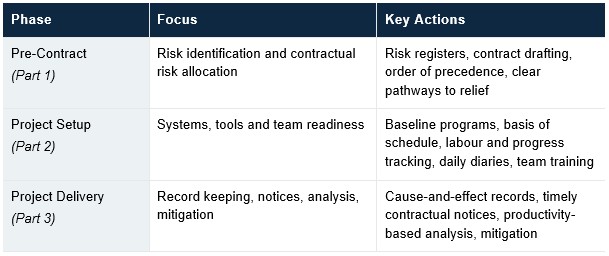
The common thread across all three phases is preparedness. Disruption is an inevitable feature of construction projects and the parties that manage it most effectively are those that plan for it, invest in the right systems and maintain the discipline to use them consistently throughout the project life cycle.
To learn more, please contact the author or the Calibrate Consulting office at info@calibrateconsulting.com.au or +61 9188 7444.
Whilst we take every care to ensure the accuracy of this information at the time of publication, the content is not intended to deal with all aspects of the subject referred to, should not be relied upon and does not constitute advice of any kind. This publication is protected by copyright © 2024 Calibrate Consulting Pty Ltd